


One storage API for local disks, object stores, and remote filesystems.





Why
Applications often need to store files in different places:
- Local disks during development
- Object storage like S3 or GCS in production
- Remote filesystems like SFTP or FTP
- Cloud providers or custom remotes
Each backend has its own API and client library.
storage provides a small, consistent interface so your application code doesn't have to change when the backend changes.
Driver Matrix
Each driver is thoroughly tested against the shared test suite using testcontainers or emulators where appropriate.
| Driver | Kind | Notes |
|---|---|---|
 | Local filesystem | Good default for local development and tests. |
 | In-memory | Best zero-dependency backend for tests and ephemeral workflows. |
 | Distributed memory | Good for temporary distributed blob storage with explicit size and durability tradeoffs. |
 | Remote filesystem | Embedded integration fixture in the shared matrix. |
 | Remote filesystem | Container-backed integration coverage in the shared matrix. |
 | Object storage | MinIO-backed integration coverage in the shared matrix. |
 | Object storage | Emulator-backed integration coverage via fake-gcs-server. |
 | Object storage | Returns temporary links; external integration strategy still open. |
 | Breadth driver | Depends on the underlying rclone remote; see the rclone storage systems overview. |
Install
Root module:
go get github.com/goforj/storageThen add the driver modules you need, for example:
go get github.com/goforj/storage/driver/localstorage
go get github.com/goforj/storage/driver/memorystorage
go get github.com/goforj/storage/driver/redisstorage
go get github.com/goforj/storage/driver/ftpstorage
go get github.com/goforj/storage/driver/sftpstorage
go get github.com/goforj/storage/driver/s3storage
go get github.com/goforj/storage/driver/gcsstorage
go get github.com/goforj/storage/driver/dropboxstorage
go get github.com/goforj/storage/driver/rclonestorage
Go compatibility
| Modules | Minimum Go version |
|---|---|
| Root, storagecore, Dropbox, FTP, local, memory, Redis, and S3 drivers | 1.24.4 |
| GCS driver and storagetest | 1.25 |
| Rclone and SFTP drivers, examples, integration, and benchmark modules | 1.26 |
The security fixes raise only the modules whose fixed dependencies require a newer toolchain. Upgrade applications that import Rclone or SFTP to Go 1.26, and applications using GCS or storagetest to Go 1.25. Applications using the remaining modules can stay on Go 1.24.4.
Usage
Choose the construction style that fits your application:
- Use a driver constructor like
localstorage.New(...)when you want a single backend directly. - Use
storage.Build(...)when you want one backend through the sharedstorageAPI. - Use
storage.New(...)when you want multiple named disks managed from config.
All storage operations also expose *Context equivalents for deadlines and cancellation. The default methods use context.Background().
Streaming objects
storage.Objects(disk) discovers the optional storagecore.ObjectStorage capability. The S3 driver supports paged object walking, streaming reads and writes, metadata preservation, version-pinned reads, and conditional reads using an observed ETag. Unsupported drivers return storage.ErrUnsupported; there is no implicit fallback that buffers whole objects in memory.
Object keys are opaque and relative to the configured disk prefix. Unlike the existing file API, these methods preserve dot segments and repeated slashes. Each operation takes an explicit context. Close every returned ObjectReader. Writes declare an exact size and leave ownership of the input reader with the caller; provide a seekable reader when provider retries are required. For non-seekable S3 uploads, HTTPS retains the SDK's streaming checksums. Plain HTTP requires explicit s3storage.Config.UnsignedPayload opt-in; only that case skips optional SDK checksum precomputation. Signed HTTP uploads require a seekable reader. The library never silently disables configured payload signing or spools whole objects to disk. Cancellation stops subsequent source reads, including SDK prehashing; a reader that blocks inside its own Read must honor cancellation or be unblocked by its owner.
Bucket creation remains explicit through s3storage.PrepareBucketContext. Ordinary storage construction and object reads never provision provider resources. Existing buffered methods, driver interfaces, and minimum Go versions are unchanged.
Common operations
package main

import (
    "errors"
    "fmt"
    "log"

    "github.com/goforj/storage"
    "github.com/goforj/storage/driver/localstorage"
)

func main() {
    disk, err := storage.Build(localstorage.Config{
        Root: "/tmp/storage",
    })
    if err != nil {
        log.Fatal(err)
    }

    // Put a file.
    if err := disk.Put("docs/readme.txt", []byte("hello")); err != nil {
        log.Fatal(err)
    }

    // Check whether the file exists.
    ok, err := disk.Exists("docs/readme.txt")
    if err != nil {
        log.Fatal(err)
    }
    fmt.Println(ok)
    // Output: true

    // Read the file back.
    data, err := disk.Get("docs/readme.txt")
    if err != nil {
        log.Fatal(err)
    }
    fmt.Println(string(data))
    // Output: hello

    // List the parent directory.
    entries, err := disk.List("docs")
    if err != nil {
        log.Fatal(err)
    }
    fmt.Println(entries[0].Path)
    // Output: docs/readme.txt

    // Delete the file.
    if err := disk.Delete("docs/readme.txt"); err != nil {
        log.Fatal(err)
    }

    // Ask the backend for an access URL when supported.
    url, err := disk.URL("docs/readme.txt")
    switch {
    case err == nil:
        fmt.Println(url)
    case errors.Is(err, storage.ErrUnsupported):
        fmt.Println("url generation unsupported")
        // Output: url generation unsupported
    default:
        log.Fatal(err)
    }
}
Single-backend construction
package main

import (
    "log"

    "github.com/goforj/storage"
    "github.com/goforj/storage/driver/localstorage"
)

func main() {
    // Build one disk through the shared storage API.
    built, err := storage.Build(localstorage.Config{
        Root: "/tmp/storage",
        Prefix: "scratch",
    })
    if err != nil {
        log.Fatal(err)
    }

    // Or construct the driver directly.
    direct, err := localstorage.New(localstorage.Config{
        Root: "/tmp/storage",
        Prefix: "scratch",
    })
    if err != nil {
        log.Fatal(err)
    }

    _, _ = built, direct
}
Manager and named disks
package main

import (
    "log"

    "github.com/goforj/storage"
    "github.com/goforj/storage/driver/localstorage"
    "github.com/goforj/storage/driver/s3storage"
)

func main() {
    // Build a manager with multiple named disks.
    mgr, err := storage.New(storage.Config{
        Default: "assets",
        Disks: map[storage.DiskName]storage.DriverConfig{
            "assets": localstorage.Config{
                Root: "/tmp/storage",
                Prefix: "assets",
            },
            "uploads": s3storage.Config{
                Bucket:          "app-uploads",
                Region:          "us-east-1",
                Endpoint:        "http://localhost:9000",
                AccessKeyID:     "minioadmin",
                SecretAccessKey: "minioadmin",
                UsePathStyle:    true,
                Prefix:          "uploads",
            },
        },
    })
    if err != nil {
        log.Fatal(err)
    }

    // Resolve a disk by name.
    disk, err := mgr.Disk("assets")
    if err != nil {
        log.Fatal(err)
    }

    // Put a file into the disk.
    if err := disk.Put("hello.txt", []byte("hello")); err != nil {
        log.Fatal(err)
    }

    // Read the file back.
    data, err := disk.Get("hello.txt")
    if err != nil {
        log.Fatal(err)
    }

    _ = data // []byte("hello")
}
Rclone
Use rclonestorage when you want to access rclone-backed remotes through the storage interface.
package main

import (
    "log"

    "github.com/goforj/storage/driver/rclonestorage"
)

const rcloneConfig = `
[localdisk]
type = local
`

func main() {
    // Build an rclone-backed disk from inline rclone config.
    disk, err := rclonestorage.New(rclonestorage.Config{
        Remote:           "localdisk:/tmp/storage",
        Prefix:           "sandbox",
        RcloneConfigData: rcloneConfig,
    })
    if err != nil {
        log.Fatal(err)
    }

    // Put a file through rclone.
    if err := disk.Put("rclone.txt", []byte("hello")); err != nil {
        log.Fatal(err)
    }

    // List files from the disk root.
    entries, err := disk.List("")
    if err != nil {
        log.Fatal(err)
    }

    _ = entries // rclone.txt
}
See examples for runnable examples.
Testing with fakes
package main

import (
    "testing"

    "github.com/goforj/storage"
    "github.com/goforj/storage/driver/memorystorage"
    "github.com/goforj/storage/storagetest"
)

func TestUpload(t *testing.T) {
    // Create one fake disk.
    disk := storagetest.Fake(t)
    _ = disk.Put("photo.jpg", []byte("ok"))

    // Or create a fake manager with named in-memory disks.
    mgr := storagetest.FakeManager(t, "photos", map[storage.DiskName]memorystorage.Config{
        "photos":  {Prefix: "photos"},
        "avatars": {Prefix: "avatars"},
    })

    photos, _ := mgr.Disk("photos")
    _ = photos.Put("one.jpg", []byte("ok"))
}
Benchmarks
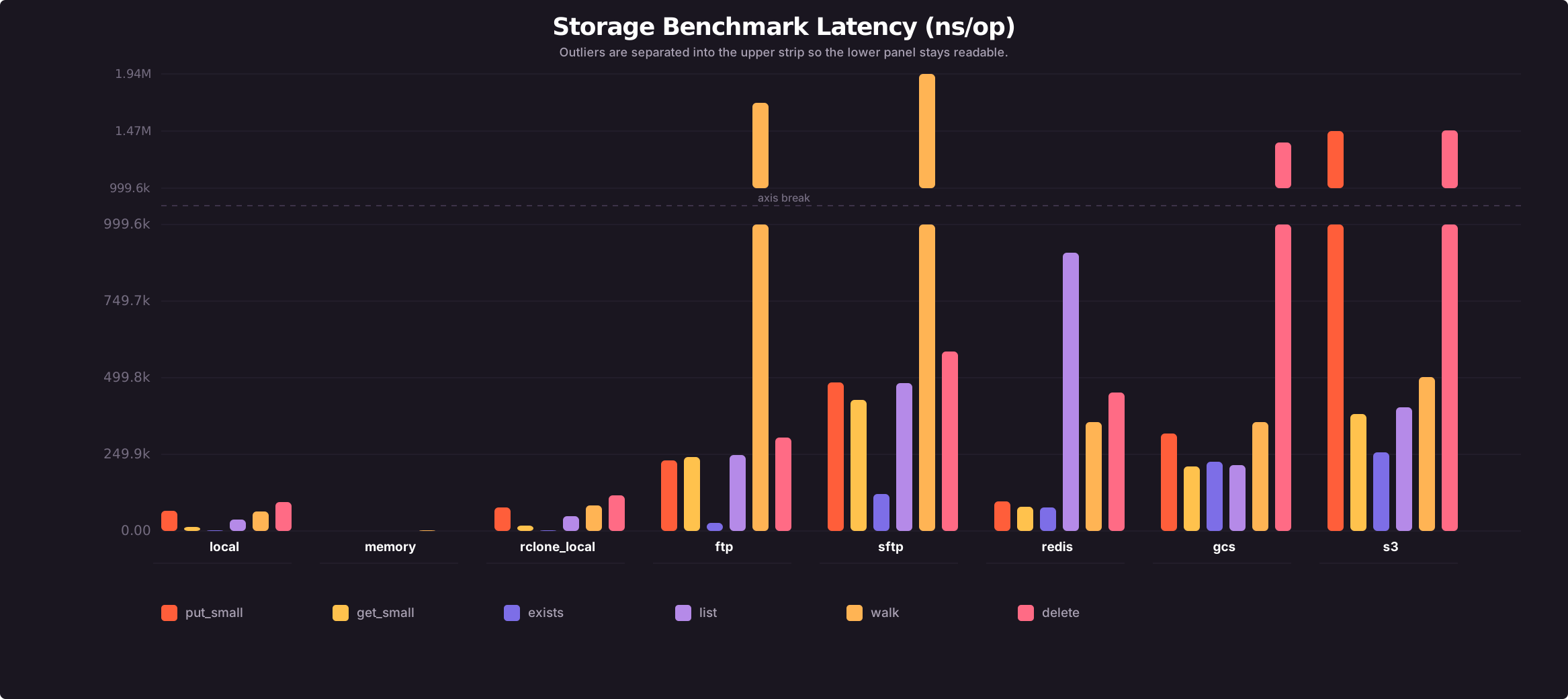
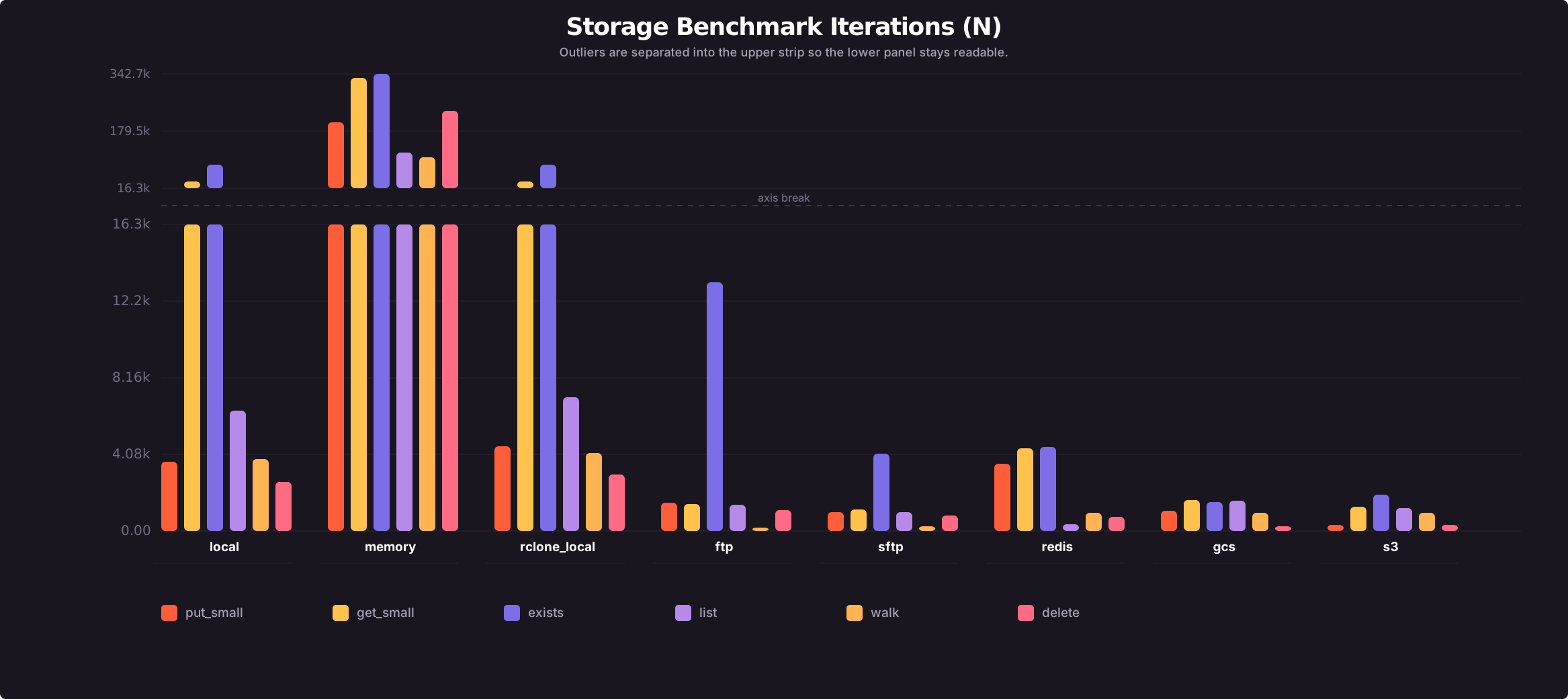
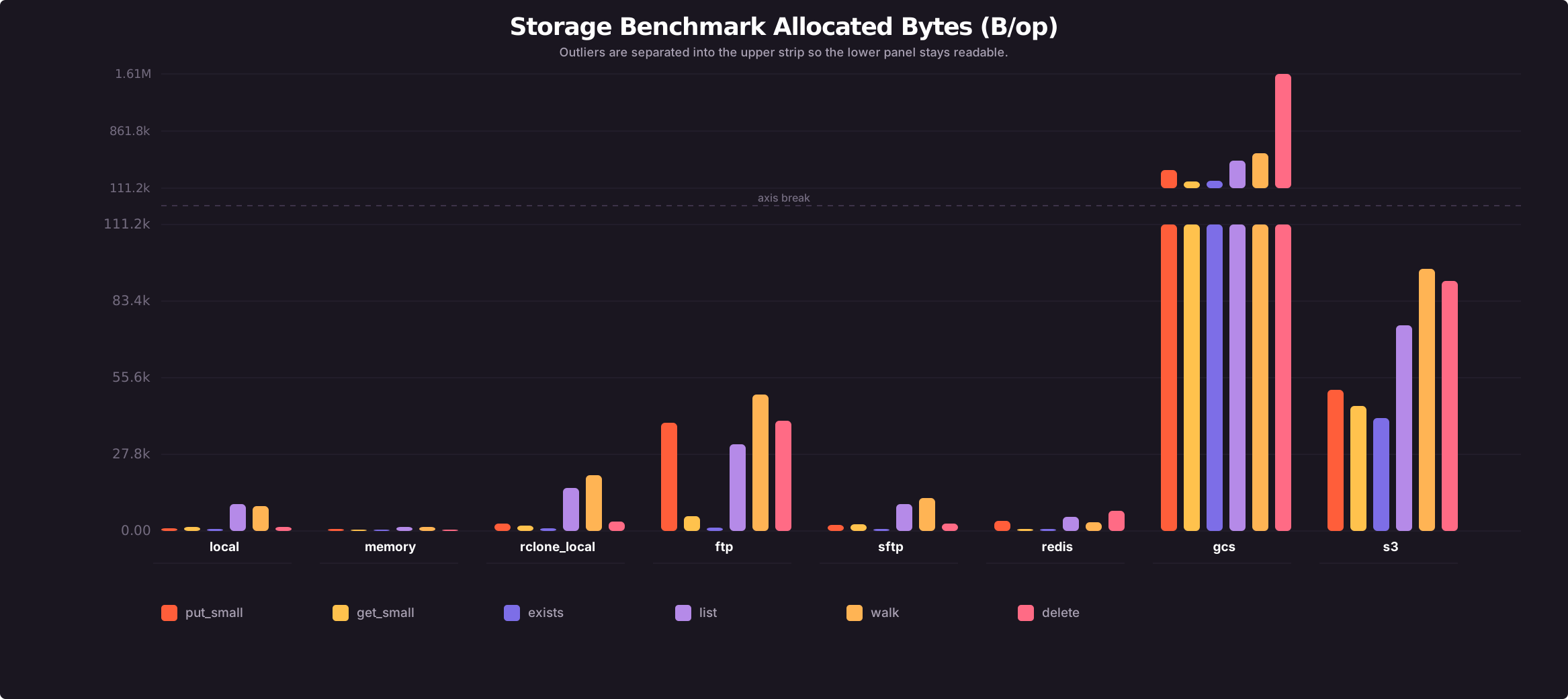
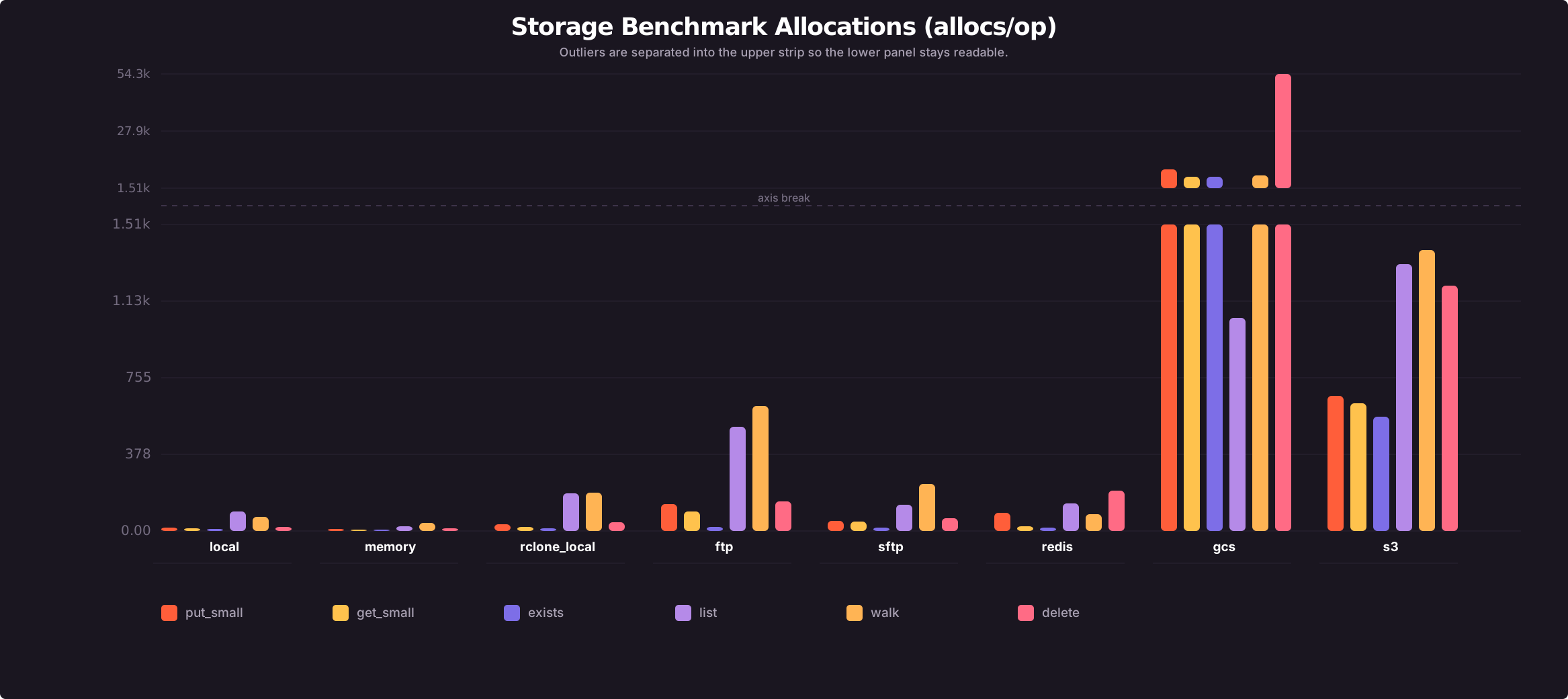
Benchmarks are rendered from docs/bench and compare the shared storage contract across representative backends.
Run the renderer with:
cd docs/bench
go test -tags benchrender . -run TestRenderBenchmarks -count=1 -v
Each chart sample uses a fixed measurement window per driver, so the ops chart remains meaningful without unbounded benchmark calibration.
Notes:
gcsuses fake-gcs-server.ftpis included by default and now reuses a logged-in control connection per storage instance during the benchmark run.redis,s3, andsftpuse testcontainers; include them withBENCH_WITH_DOCKER=1or by explicitly settingBENCH_DRIVER.rclone_localmeasures rclone overhead on top of a local filesystem remote.
Latency (ns/op)
Iterations (N)
Allocated Bytes (B/op)
Allocations (allocs/op)
Capability Matrix
| Driver | Stat | Copy | Move | Walk | URL | Context |
|---|---|---|---|---|---|---|
| ✓ | ✓ | ✓ | ✓ | ✗ | ✓ |
| ✓ | ✓ | ✓ | ✓ | ✗ | ✓ |
| ✓ | ✓ | ✓ | ✓ | ✗ | ✓ |
| ✓ | ✓ | ✓ | ✓ | ✗ | ✓ |
| ✓ | ✓ | ✓ | ✓ | ✗ | ✓ |
| ✓ | ✓ | ✓ | ✓ | ✓ | ✓ |
| ✓ | ✓ | ✓ | ✓ | ~ | ✓ |
| ✓ | ✓ | ✓ | ✓ | ✓ | ✓ |
| ✓ | ✓ | ✓ | ✓ | ~ | ✓ |
~ indicates backend- or environment-dependent behavior. For example, GCS URL generation is unavailable in emulator mode and rclone URL support depends on the underlying remote.
Migration notes
- Go 1.24.4 or newer is required. Local replacement remains atomic and confined to the configured root on the supported platforms.
- Redis clients sharing a database and prefix require a coordinated cutover: stop all clients before upgrading them together because older releases cannot read or validate new v2 index writes.
- SFTP configurations must provide
KnownHostsPathunlessInsecureIgnoreHostKeyis explicitly enabled. The insecure option should be limited to controlled test environments. - Dropbox
Deletesupports files only and uses revision-conditional deletion. Directory deletion returnsstorage.ErrUnsupportedbecause recursiveDeleteV2could otherwise remove children created after an empty-directory preflight. - Empty and root-like paths identify a disk's logical root; the root cannot be mutated or aliased as an object by
Put,Delete,Copy, orMove. - Resource-backed disks should be closed when they implement
interface{ Close() error }. Always callManager.Close()when a manager is no longer needed so its initialized disks are released.
API reference
The API section below is autogenerated; do not edit between the markers.
API Index
Config
rclonestorage.LocalRemote
LocalRemote defines a local backend configuration.
Example: define a local remote
remote := rclonestorage.LocalRemote{Name: "local"}
fmt.Println(remote.Name)
// Output: local
Example: define a local remote with all fields
remote := rclonestorage.LocalRemote{
	Name: "local",
}
fmt.Println(remote.Name)
// Output: local
rclonestorage.MustRenderLocal
MustRenderLocal panics on error.
cfg := rclonestorage.MustRenderLocal(rclonestorage.LocalRemote{Name: "local"})
fmt.Println(cfg)
// Output:
// [local]
// type = local
rclonestorage.MustRenderS3
MustRenderS3 panics on error.
cfg := rclonestorage.MustRenderS3(rclonestorage.S3Remote{
	Name:            "assets",
	Region:          "us-east-1",
	AccessKeyID:     "key",
	SecretAccessKey: "secret",
})
fmt.Println(cfg)
// Output:
// [assets]
// type = s3
// provider = AWS
// access_key_id = key
// secret_access_key = secret
// region = us-east-1
rclonestorage.RenderLocal
RenderLocal returns ini-formatted rclone config for a local backend.
cfg, _ := rclonestorage.RenderLocal(rclonestorage.LocalRemote{Name: "local"})
fmt.Println(cfg)
// Output:
// [local]
// type = local
rclonestorage.RenderS3
RenderS3 returns ini-formatted rclone config content for a single S3 remote.
cfg, _ := rclonestorage.RenderS3(rclonestorage.S3Remote{
	Name:            "assets",
	Region:          "us-east-1",
	AccessKeyID:     "key",
	SecretAccessKey: "secret",
})
fmt.Println(cfg)
// Output:
// [assets]
// type = s3
// provider = AWS
// access_key_id = key
// secret_access_key = secret
// region = us-east-1
rclonestorage.S3Remote
S3Remote defines parameters for constructing an rclone S3 remote.
Example: define an s3 remote
remote := rclonestorage.S3Remote{
	Name:            "assets",
	Region:          "us-east-1",
	AccessKeyID:     "key",
	SecretAccessKey: "secret",
}
fmt.Println(remote.Name)
// Output: assets
Example: define an s3 remote with all fields
remote := rclonestorage.S3Remote{
	Name:               "assets",
	Endpoint:           "http://localhost:9000", // default: ""
	Region:             "us-east-1",
	AccessKeyID:        "key",
	SecretAccessKey:    "secret",
	Provider:           "AWS",    // default: "AWS"
	PathStyle:          false,    // default: false
	BucketACL:          "private", // default: ""
	UseUnsignedPayload: false,    // default: false
}
fmt.Println(remote.Name)
// Output: assets
Construction
Build
Build constructs a single storage backend from a typed driver config without a Manager.
fs, _ := storage.Build(localstorage.Config{
	Root: "/tmp/storage-example",
	Prefix: "assets",
})
DriverConfig
DriverConfig is implemented by typed driver configs such as local.Config or s3storage.Config. It is the public config boundary for Manager and Build.
var cfg storage.DriverConfig = localstorage.Config{
	Root: "/tmp/storage-config",
}
DriverFactory
DriverFactory constructs a Storage for a given normalized disk configuration.
factory := storage.DriverFactory(func(ctx context.Context, cfg storage.ResolvedConfig) (storage.Storage, error) {
	return nil, nil
})
ResolvedConfig
ResolvedConfig is the normalized internal config passed to registered drivers. Users should prefer typed driver configs and treat this as registry adapter glue, not the primary construction API.
factory := storage.DriverFactory(func(ctx context.Context, cfg storage.ResolvedConfig) (storage.Storage, error) {
	fmt.Println(cfg.Driver)
	// Output: memory
	return nil, nil
})

_, _ = factory(context.Background(), storage.ResolvedConfig{Driver: "memory"})
Context
BuildContext
BuildContext constructs a single storage backend from a typed driver config using the caller-provided context.
CountFilesContext
CountFilesContext returns the recursive count of non-directory entries under path using the caller-provided context.
Core
CountFiles
CountFiles returns the recursive count of non-directory entries under path.
CountFiles uses Walk under the hood, so it works across drivers that support recursive traversal.
disk, _ := storage.Build(localstorage.Config{
	Root: "/tmp/storage-count-files",
})
_ = disk.MakeDir("docs/archive")
_ = disk.Put("docs/readme.txt", []byte("hello"))
_ = disk.Put("docs/archive/guide.txt", []byte("guide"))

total, _ := storage.CountFiles(disk, "docs")
fmt.Println(total)
// Output: 2
DiskName
DiskName is a typed identifier for configured disks.
const uploads storage.DiskName = "uploads"
fmt.Println(uploads)
// Output: uploads
Entry
Entry represents an item returned by List.
Path is relative to the storage namespace, not an OS-native path. Directory-like entries are listing artifacts, not a promise of POSIX-style storage semantics.
entry := storage.Entry{
	Path:  "docs/readme.txt",
	Size:  5,
	IsDir: false,
}
fmt.Println(entry.Path, entry.IsDir)
// Output: docs/readme.txt false
ListPageResult
ListPageResult describes a paginated one-level directory listing.
PagedStorage
PagedStorage exposes paginated one-level listing when a backend can support it. Use Storage for the common path and type-assert to PagedStorage when you need backend-driven pagination.
PagedStorage.ListPage
ListPage returns one page of immediate children under path.
Storage
Storage is the public interface for interacting with a storage backend.
Semantics:
- Put overwrites an existing object at the same path.
- MakeDir creates a directory-like prefix and may be implemented as a backend-specific directory marker on object stores.
- List is one-level, non-recursive, and sorted lexicographically by Path.
- List with an empty path lists from the disk root or prefix root.
- Walk is recursive and visits entries lexicographically by Path.
- URL returns a usable access URL when the driver supports it.
- Copy overwrites the destination object when the backend supports copy semantics.
- Move relocates an object or directory tree and may be implemented as copy followed by delete. Directory moves roll back destination entries if copying fails. A failure while deleting the source may leave a complete destination alongside the undeleted source remainder.
- Unsupported operations should return ErrUnsupported.
var disk storage.Storage
disk, _ = storage.Build(localstorage.Config{
	Root: "/tmp/storage-interface",
})
Storage.Copy
Copy copies the object at src to dst.
disk, _ := storage.Build(localstorage.Config{
	Root: "/tmp/storage-copy",
})
_ = disk.Put("docs/readme.txt", []byte("hello"))
_ = disk.Copy("docs/readme.txt", "docs/copy.txt")

data, _ := disk.Get("docs/copy.txt")
fmt.Println(string(data))
// Output: hello
Storage.Delete
Delete removes the object at path.
disk, _ := storage.Build(localstorage.Config{
	Root: "/tmp/storage-delete",
})
_ = disk.Put("docs/readme.txt", []byte("hello"))
_ = disk.Delete("docs/readme.txt")

ok, _ := disk.Exists("docs/readme.txt")
fmt.Println(ok)
// Output: false
Storage.Exists
Exists reports whether an object exists at path.
disk, _ := storage.Build(localstorage.Config{
	Root: "/tmp/storage-exists",
})
_ = disk.Put("docs/readme.txt", []byte("hello"))

ok, _ := disk.Exists("docs/readme.txt")
fmt.Println(ok)
// Output: true
Storage.Get
Get reads the object at path.
disk, _ := storage.Build(localstorage.Config{
	Root: "/tmp/storage-get",
})
_ = disk.Put("docs/readme.txt", []byte("hello"))

data, _ := disk.Get("docs/readme.txt")
fmt.Println(string(data))
// Output: hello
Storage.List
List returns the immediate children under path.
disk, _ := storage.Build(localstorage.Config{
	Root: "/tmp/storage-list",
})
_ = disk.Put("docs/readme.txt", []byte("hello"))

entries, _ := disk.List("docs")
fmt.Println(entries[0].Path)
// Output: docs/readme.txt
Storage.MakeDir
MakeDir creates a directory-like entry at path.
disk, _ := storage.Build(localstorage.Config{
	Root: "/tmp/storage-mkdir",
})
Storage.Move
Move moves the object or directory tree at src to dst.
Example: move an object
disk, _ := storage.Build(localstorage.Config{
	Root: "/tmp/storage-move",
})
_ = disk.Put("docs/readme.txt", []byte("hello"))
_ = disk.Move("docs/readme.txt", "docs/archive.txt")

ok, _ := disk.Exists("docs/readme.txt")
fmt.Println(ok)
// Output: false
Example: move a directory tree
disk, _ := storage.Build(localstorage.Config{
	Root: "/tmp/storage-move-dir",
})
_ = disk.MakeDir("docs/archive")
_ = disk.Put("docs/archive/readme.txt", []byte("hello"))
_ = disk.Move("docs/archive", "docs/published")

entry, _ := disk.Stat("docs/published")
fmt.Println(entry.IsDir)
// Output: true
Storage.Put
Put writes an object at path, overwriting any existing object.
disk, _ := storage.Build(localstorage.Config{
	Root: "/tmp/storage-put",
})
_ = disk.Put("docs/readme.txt", []byte("hello"))
fmt.Println("stored")
// Output: stored
Storage.Stat
Stat returns the entry at path.
disk, _ := storage.Build(localstorage.Config{
	Root: "/tmp/storage-stat",
})
_ = disk.Put("docs/readme.txt", []byte("hello"))

entry, _ := disk.Stat("docs/readme.txt")
fmt.Println(entry.Path, entry.Size)
// Output: docs/readme.txt 5
Storage.URL
URL returns a usable access URL when the driver supports it.
Example: request an object url
disk, _ := storage.Build(s3storage.Config{
	Bucket: "uploads",
	Region: "us-east-1",
})

url, _ := disk.URL("docs/readme.txt")
Example: handle unsupported url generation
disk, _ := storage.Build(localstorage.Config{
	Root: "/tmp/storage-url",
})

_, err := disk.URL("docs/readme.txt")
fmt.Println(errors.Is(err, storage.ErrUnsupported))
// Output: true
Storage.Walk
Walk visits entries recursively in deterministic path order.
disk, _ := storage.Build(localstorage.Config{
	Root: "/tmp/storage-walk",
})
_ = disk.Put("docs/readme.txt", []byte("hello"))

err := disk.Walk("", func(entry storage.Entry) error {
	fmt.Println(entry.Path)
	return nil
})
fmt.Println(err == nil)
// Output:
// docs
// docs/readme.txt
// true
Storage.WithContext
WithContext returns a derived storage handle bound to ctx for subsequent operations.
disk, _ := storage.Build(localstorage.Config{
	Root: "/tmp/storage-with-context",
})
_ = disk.Put("docs/readme.txt", []byte("hello"))

ctx, cancel := context.WithTimeout(context.Background(), time.Second)
defer cancel()

data, _ := disk.WithContext(ctx).Get("docs/readme.txt")
fmt.Println(string(data))
// Output: hello
Driver Config
dropboxstorage.Config
Config defines a Dropbox-backed storage disk.
Example: define dropbox storage config
cfg := dropboxstorage.Config{
	Token: "token",
}
Example: define dropbox storage config with all fields
cfg := dropboxstorage.Config{
	Token:  "token",
	Prefix: "uploads", // default: ""
}
ftpstorage.Config
Config defines an FTP-backed storage disk.
Example: define ftp storage config
cfg := ftpstorage.Config{
	Host:     "127.0.0.1",
	User:     "demo",
	Password: "secret",
}
Example: define ftp storage config with all fields
cfg := ftpstorage.Config{
	Host:               "127.0.0.1",
	Port:               21,        // default: 21
	User:               "demo",    // default: ""
	Password:           "secret",  // default: ""
	TLS:                false,     // default: false
	InsecureSkipVerify: false,     // default: false
	Prefix:             "uploads", // default: ""
}
gcsstorage.Config
Config defines a GCS-backed storage disk.
Example: define gcs storage config
cfg := gcsstorage.Config{
	Bucket: "uploads",
}
Example: define gcs storage config with all fields
cfg := gcsstorage.Config{
	Bucket:          "uploads",
	CredentialsJSON: "{...}",              // default: ""
	Endpoint:        "http://127.0.0.1:0", // default: ""
	Prefix:          "assets",             // default: ""
}
localstorage.Config
Config defines local storage rooted at a filesystem path.
Example: define local storage config
cfg := localstorage.Config{
	Root:   "/tmp/storage-local",
	Prefix: "sandbox",
}
Example: define local storage config with all fields
cfg := localstorage.Config{
	Root:   "/tmp/storage-local",
	Prefix: "sandbox", // default: ""
}
memorystorage.Config
Config defines an in-memory storage disk.
Example: define memory storage config
cfg := memorystorage.Config{}Example: define memory storage config with all fields
cfg := memorystorage.Config{
	Prefix: "sandbox", // default: ""
}
rclonestorage.Config
Config defines an rclone-backed storage disk.
Example: define rclone storage config
cfg := rclonestorage.Config{
	Remote: "local:",
	Prefix: "sandbox",
}
Example: define rclone storage config with all fields
cfg := rclonestorage.Config{
	Remote:           "local:",
	Prefix:           "sandbox",                  // default: ""
	RcloneConfigPath: "/path/to/rclone.conf",     // default: ""
	RcloneConfigData: "[local]\ntype = local\n",  // default: ""
}
s3storage.Config
Config defines an S3-backed storage disk.
Example: define s3 storage config
cfg := s3storage.Config{
	Bucket: "uploads",
	Region: "us-east-1",
}
Example: define s3 storage config with all fields
cfg := s3storage.Config{
	Bucket:          "uploads",
	Endpoint:        "http://localhost:9000", // default: ""
	Region:          "us-east-1",
	AccessKeyID:     "minioadmin", // default: ""
	SecretAccessKey: "minioadmin", // default: ""
	UsePathStyle:    true,         // default: false
	UnsignedPayload: false,        // default: false
	Prefix:          "assets",     // default: ""
}
sftpstorage.Config
Config defines an SFTP-backed storage disk.
Example: define sftp storage config
cfg := sftpstorage.Config{
	Host:     "127.0.0.1",
	User:     "demo",
	Password: "secret",
}
Example: define sftp storage config with all fields
cfg := sftpstorage.Config{
	Host:                  "127.0.0.1",
	Port:                  22,            // default: 22
	User:                  "demo",        // default: "root"
	Password:              "secret",      // default: ""
	KeyPath:               "/path/id_ed25519",      // default: ""
	KnownHostsPath:        "/path/known_hosts",     // default: ""
	InsecureIgnoreHostKey: false,         // default: false
	Prefix:                "uploads",     // default: ""
}
Driver Constructors
dropboxstorage.New
New constructs Dropbox-backed storage using the official SDK.
fs, _ := dropboxstorage.New(dropboxstorage.Config{
	Token: "token",
})
ftpstorage.New
New constructs FTP-backed storage using jlaffaye/ftp.
fs, _ := ftpstorage.New(ftpstorage.Config{
	Host:     "127.0.0.1",
	User:     "demo",
	Password: "secret",
})
gcsstorage.New
New constructs GCS-backed storage using cloud.google.com/go/storage.
fs, _ := gcsstorage.New(gcsstorage.Config{
	Bucket: "uploads",
})
localstorage.New
New constructs local storage rooted at cfg.Root with an optional prefix.
fs, _ := localstorage.New(localstorage.Config{
	Root:   "/tmp/storage-local",
	Prefix: "sandbox",
})
memorystorage.New
New constructs in-memory storage.
fs, _ := memorystorage.New(memorystorage.Config{
	Prefix: "sandbox",
})
rclonestorage.New
New constructs an rclone-backed storage. All disks share a single config path.
Example: rclone storage
fs, _ := rclonestorage.New(rclonestorage.Config{
	Remote: "local:",
	Prefix: "sandbox",
})
Example: rclone storage with inline config
fs, _ := rclonestorage.New(rclonestorage.Config{
	Remote: "localdisk:/tmp/storage",
	RcloneConfigData: `

[localdisk]
type = local
`,

})
s3storage.New
New constructs S3-backed storage using AWS SDK v2.
fs, _ := s3storage.New(s3storage.Config{
	Bucket: "uploads",
	Region: "us-east-1",
})
sftpstorage.New
New constructs SFTP-backed storage using ssh and pkg/sftp.
fs, _ := sftpstorage.New(sftpstorage.Config{
	Host:     "127.0.0.1",
	User:     "demo",
	Password: "secret",
})
Manager
Config
Config defines named disks using typed driver configs.
cfg := storage.Config{
	Default: "local",
	Disks: map[storage.DiskName]storage.DriverConfig{
		"local": localstorage.Config{Root: "/tmp/storage-manager"},
	},
}
Manager
Manager holds named storage disks.
mgr, _ := storage.New(storage.Config{
	Default: "local",
	Disks: map[storage.DiskName]storage.DriverConfig{
		"local": localstorage.Config{Root: "/tmp/storage-manager"},
	},
})
Manager.Default
Default returns the default disk or panics if misconfigured.
mgr, _ := storage.New(storage.Config{
	Default: "local",
	Disks: map[storage.DiskName]storage.DriverConfig{
		"local": localstorage.Config{Root: "/tmp/storage-default"},
	},
})

fs := mgr.Default()
fmt.Println(fs != nil)
// Output: true
Manager.Disk
Disk returns a named disk or an error if it does not exist.
mgr, _ := storage.New(storage.Config{
	Default: "local",
	Disks: map[storage.DiskName]storage.DriverConfig{
		"local":   localstorage.Config{Root: "/tmp/storage-default"},
		"uploads": localstorage.Config{Root: "/tmp/storage-uploads"},
	},
})

fs, _ := mgr.Disk("uploads")
fmt.Println(fs != nil)
// Output: true
New
New constructs a Manager and eagerly initializes all disks.
mgr, _ := storage.New(storage.Config{
	Default: "local",
	Disks: map[storage.DiskName]storage.DriverConfig{
		"local":  localstorage.Config{Root: "/tmp/storage-local"},
		"assets": localstorage.Config{Root: "/tmp/storage-assets", Prefix: "public"},
	},
})
RegisterDriver
RegisterDriver makes a driver available to the Manager. It panics on duplicate registrations.
storage.RegisterDriver("memory", func(ctx context.Context, cfg storage.ResolvedConfig) (storage.Storage, error) {
	return nil, nil
})
Other
Config.DriverName
DriverName returns the registry name for local storage.
Config.ResolvedConfig
ResolvedConfig translates Config into the shared driver boundary.
Manager.Close
Close releases all initialized disks once in reverse deterministic construction order.
PaginateEntries
PaginateEntries returns a clamped page without mutating the caller's entry slice.
dropboxstorage.NewContext
NewContext constructs Dropbox-backed storage and honors cancellation during setup.
ftpstorage.NewContext
NewContext validates cfg and constructs a lazily connected FTP store.
gcsstorage.NewContext
NewContext validates cfg and creates a context-aware GCS store.
localstorage.NewContext
NewContext constructs local storage and honors cancellation during setup.
memorystorage.NewContext
NewContext validates cfg and creates an isolated in-memory store.
rclonestorage.NewContext
NewContext validates cfg and constructs an rclone-backed store.
s3storage.NewContext
NewContext constructs S3-backed storage and honors cancellation during setup.
sftpstorage.NewContext
NewContext validates cfg and establishes an SFTP session.
Paths
JoinPrefix
JoinPrefix combines a disk prefix with a path using slash separators.
fmt.Println(storage.JoinPrefix("assets", "logo.svg"))
// Output: assets/logo.svg
NormalizePath
NormalizePath cleans a user path, normalizes separators, and rejects attempts to escape the disk root or prefix root.
The empty string and root-like inputs normalize to the logical root.
p, _ := storage.NormalizePath(" /avatars//user-1.png ")
fmt.Println(p)
// Output: avatars/user-1.png
Contributing
Shared contract tests live in storagetest.
Centralized integration coverage lives in integration and runs the same contract across supported backends. That centralized matrix is the authoritative integration path for the repository.
Current fixture types in the centralized matrix:
- testcontainers:
s3,sftp - emulator:
gcs - embedded/local fixtures:
local,ftp,rclone_local
Development
Use make test for root-module tests, make test-examples for the examples module, and make test-coverage for the Codecov report. make test-integration runs the centralized matrix; pass a driver such as make test-integration gcs to select one backend. Integration may require Docker. make bench and make bench-render retain the benchmark workflow, while the modules-check, release-tag, release-plan, and release-publish targets support publication.
Using with GoForj
GoForj Apps expose named disks through generated accessors. Use those accessors in application services and keep backend selection in storage configuration.
For the App workflow, see Storage Patterns.